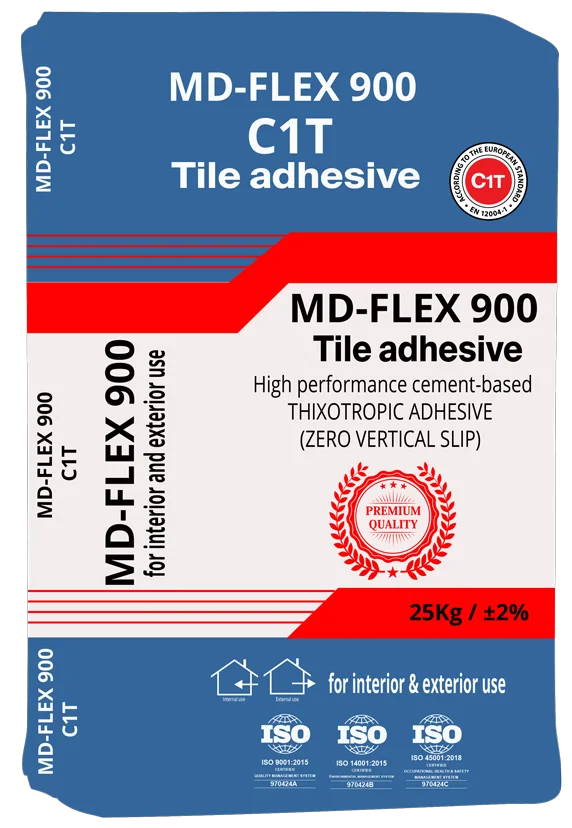
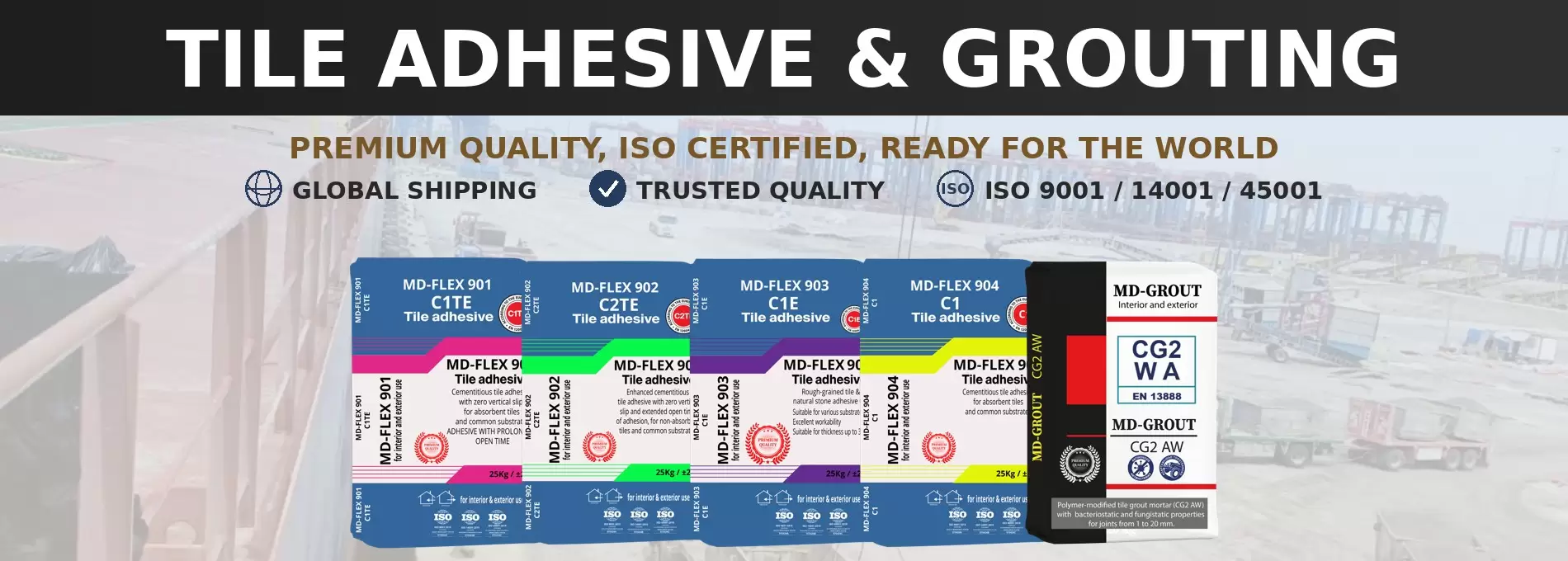
Md-FLEX showcase a comprehensive line of professional construction materials specifically designed for tiling and grouting applications in both indoor and outdoor environments. 

This product range includes various cement-based adhesives, such as the MD-FLEX series, which cater to different technical needs like high elasticity, zero vertical slip, and extended working times. 

Specialized options are available for unique requirements, including natural stone installation and the placement of large-format tiles on building facades. Additionally, the collection features

Tile Adhesive and Grouting

Tile Adhesive and Grouting

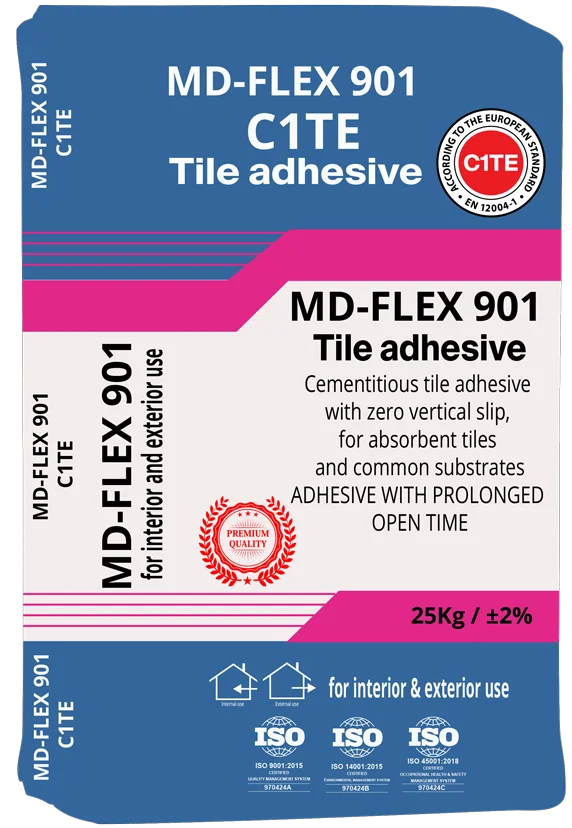
MD-FLEX 901 (C1TE)
Cementitious tile adhesive with zero vertical slip, for absorbent tiles and common substrates ADHESIVE WITH PROLONGED OPEN TIME
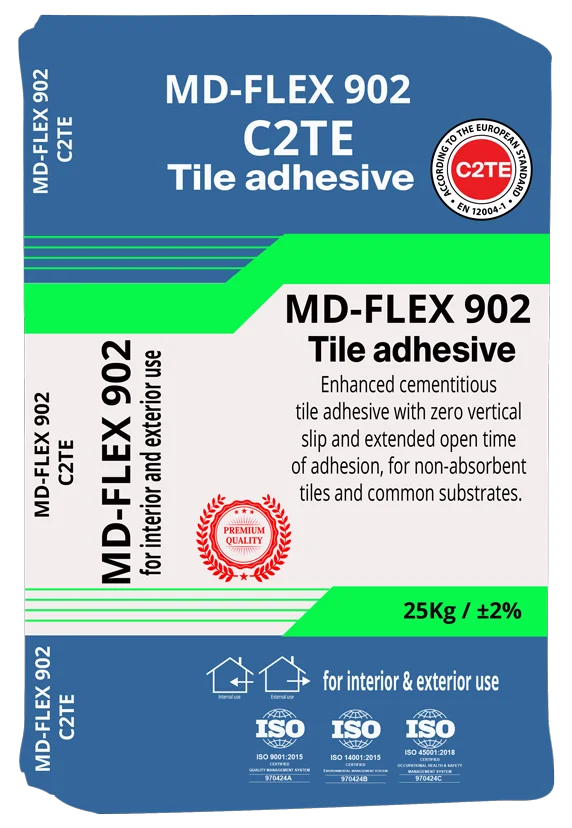
MD-FLEX 902 (C2TE)
Suitable for indoor and outdoor applications .Enhanced cementitious tile adhesive with zero vertical slip and extended open time of adhesion, for non-absorbent tiles and common substrates.
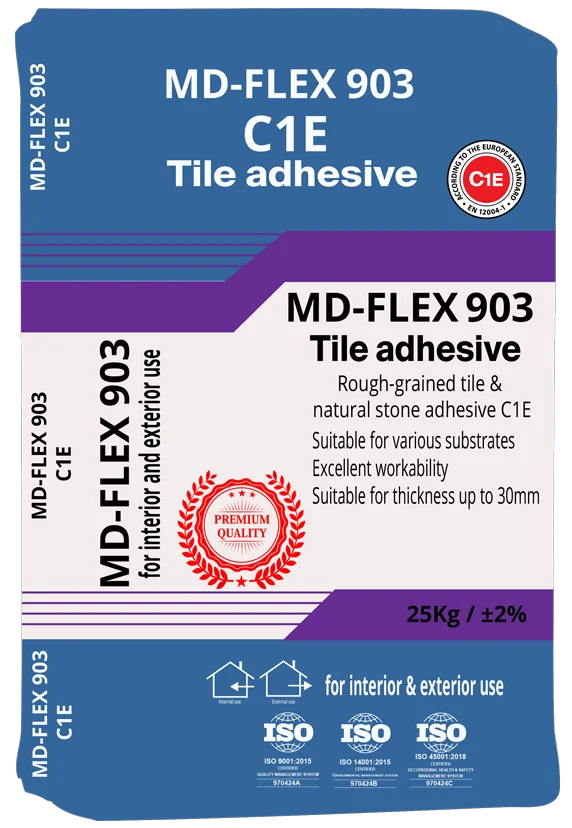
MD-FLEX 903 (C1TE)
Rough-grained tile & natural stone adhesive C1E Suitable for various substrates Excellent workability Suitable for thickness up to 30 mm
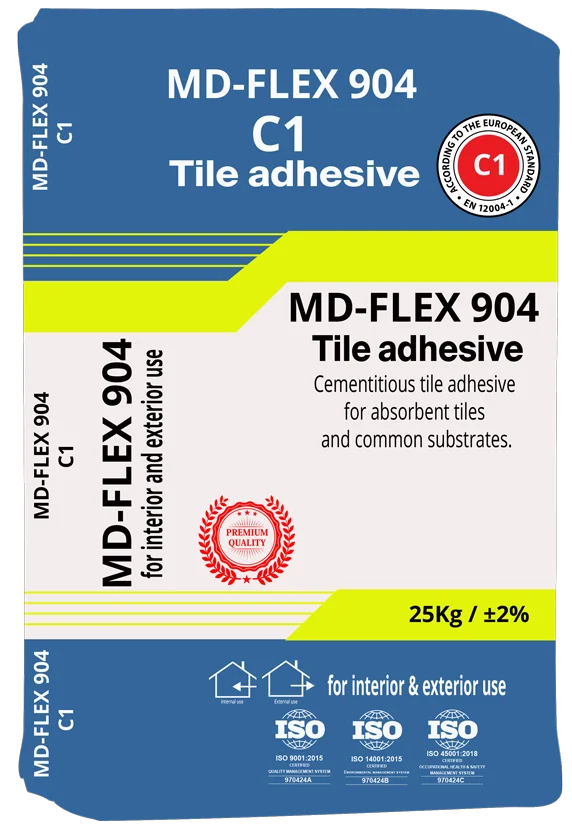
MD-FLEX 904 (C1)
General purpose, cementitious tile adhesive with high slip resistance use
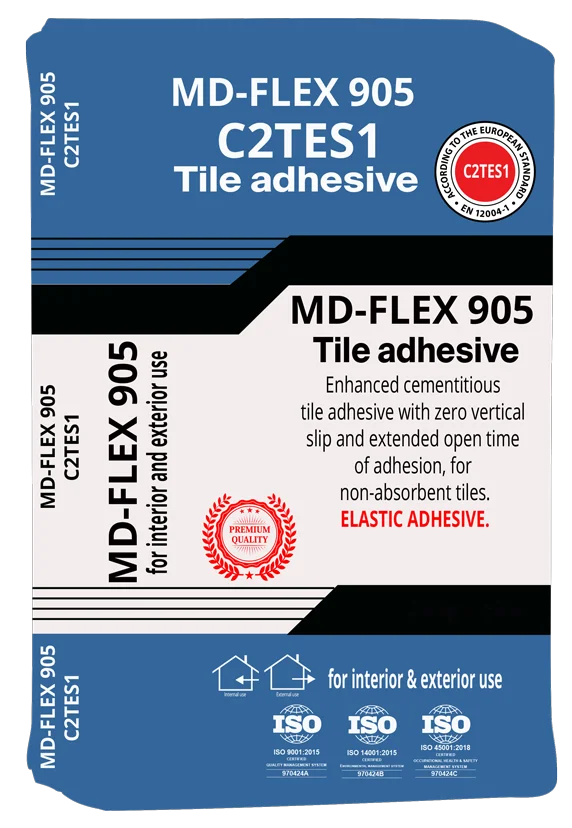
MD-FLEX 905 (C2TES1)
Enhanced cementitious tile adhesive with zero vertical slip and extended open time of adhesion, for non-absorbent tiles. ELASTIC ADHESIVE.
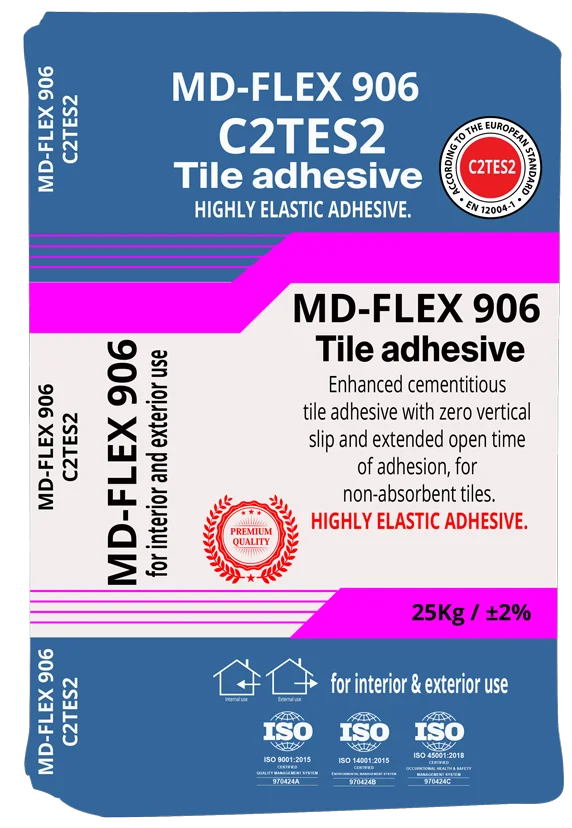
MD-FLEX 906 (C2TES2)
Ultra-deformable, high-performance cement based tile adhesive (C2TES2), for fixing large formats and tiling on facades.
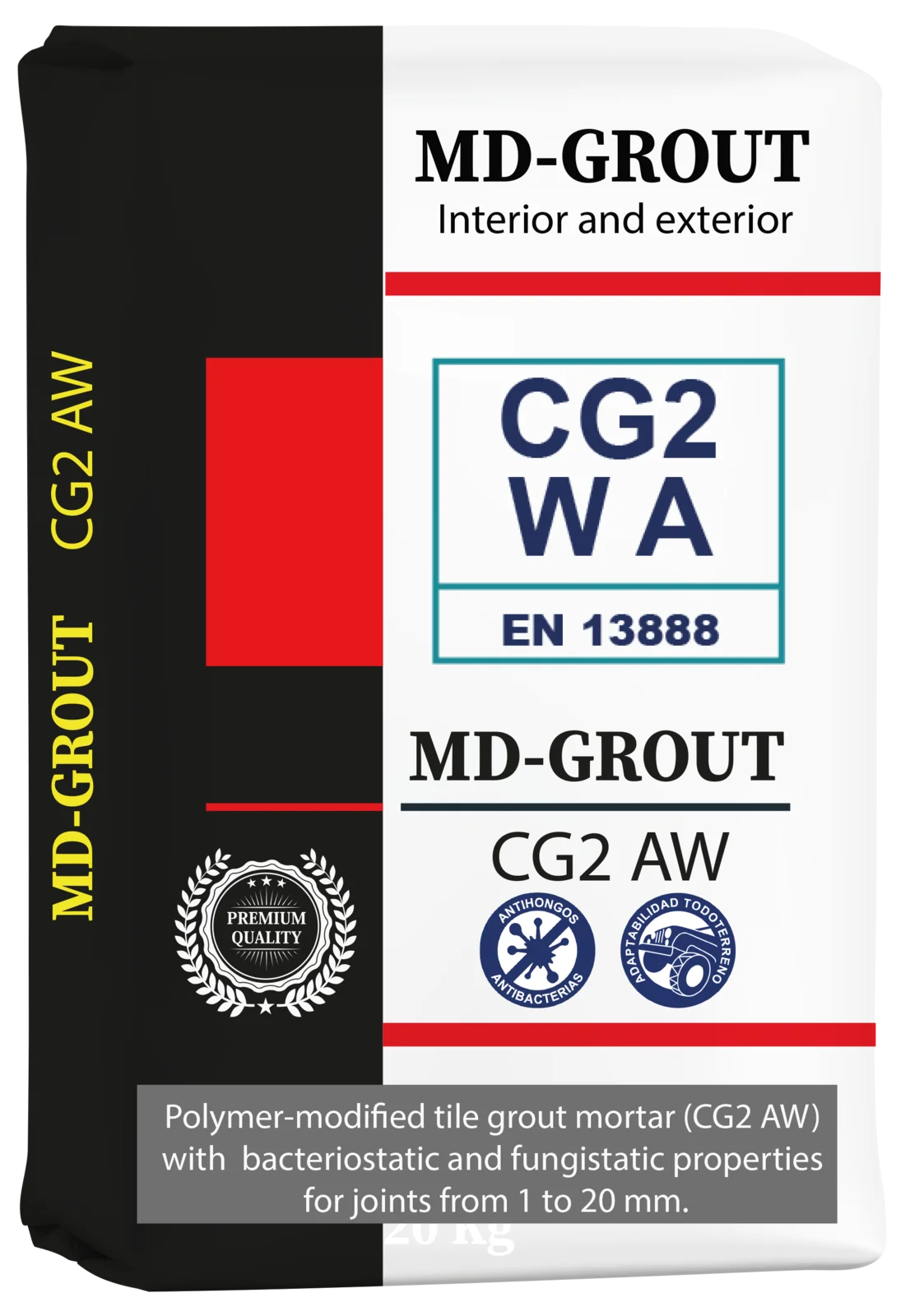
MD-GROUT
Polymer-modified tile grout mortar (CG2 AW) with bacteriostatic and fungistatic properties for joints from 1 to 20 mm. Interior and exterior

Complete Guide to Tile Adhesives
 Introduction & EN 12004-1 Classification

Introduction to Tile Adhesives

Selecting the right tile adhesive is the most critical step in ensuring a durable, long-lasting tile installation. Whether you are tiling a standard bathroom wall, a high-traffic commercial floor, or a fully submerged swimming pool, the adhesive must be specifically formulated to handle the environment, the substrate, and the type of tile being used.Modern tile adhesives are highly engineered products designed to provide superior bond strength, flexibility, and ease of application. To ensure quality and safety across the construction industry, these adhesives are strictly regulated and classified by international standards.

Understanding the EN 12004-1 Standard

In the global construction industry, EN 12004-1 is the recognized European standard that specifies the performance requirements for tile adhesives.

Instead of guessing which product is best, the EN 12004-1 standard provides a clear, alphanumeric coding system (like C2TES1) printed on every bag or bucket. This code acts as the product’s "DNA," telling contractors and builders exactly how the adhesive will perform under different conditions.

The classification is broken down into three main categories: Adhesive Chemistry, Performance Level, and Special Characteristics.

Adhesive Chemistry (The Base Type)

The first letter in the classification code dictates the chemical makeup of the adhesive.

  • C (Cementitious): Powders mixed with water (or a liquid latex additive) before use. These are the most common and versatile adhesives used in construction.

  • D (Dispersion): Ready-to-use pastes that require no mixing. They dry through the evaporation of water. Best suited for interior wall applications and smaller tiles.

  • R (Reaction Resin): Multi-component adhesives (like epoxies or polyurethanes) that cure through a chemical reaction. These offer extreme strength and chemical resistance, making them ideal for heavy industrial or hygienic environments.

Performance Level (The Class)

Directly following the base letter is a number that indicates the adhesive's bond strength.

  • Class 1 (Normal Performance): Standard adhesive suitable for most basic, low-stress applications.

  • Class 2 (Improved Performance): High-strength adhesive with added polymers. Required for larger tiles, non-porous tiles (like porcelain), exterior use, or areas subject to temperature changes and water exposure.

Special Characteristics (Optional Features)

etters added to the end of the code indicate specialized performance enhancements designed to solve specific installation challenges.

  • F (Fast-Setting): Cures rapidly. Essential for projects that require quick turnaround times, such as commercial floors that need to handle foot traffic within a few hours.

  • T (Reduced Slip): Highly thixotropic. When you press a heavy tile into the adhesive on a vertical wall, it will not slip down.

  • E (Extended Open Time): The adhesive remains wet and workable on the substrate for a longer period before skinning over. Ideal for hot climates, large floor areas, or intricate tile patterns.

Deformability / Flexibility (S-Class)

For cementitious adhesives (Type C), the ability to flex and absorb movement without cracking is crucial, especially on suspended wooden floors or underfloor heating systems.

  • S1 (Deformable): The cured adhesive can deform (bend) between 2.5 mm and 5 mm.

  • S2 (Highly Deformable): The cured adhesive can deform by more than 5 mm. Provides maximum flexibility for extreme vibration or temperature fluctuations.

Quick Reference Classification Chart

Use this table to quickly decode any tile adhesive product:

Code Meaning Common Application Example
C1 Standard Cementitious Standard ceramic tiles on indoor concrete floors.
C2 Improved Cementitious Porcelain tiles or outdoor patio installations.
D1 Standard Dispersion Ceramic wall tiles in a dry, interior room.
R2 Improved Reaction Resin Industrial kitchen floors exposed to heavy chemicals.
C2T Improved, Non-Slip Installing large-format tiles on bathroom walls.
C2F Improved, Fast-Setting Retail store floor tiling requiring next-day opening.
C2TES1 Improved, Non-Slip, Extended Open Time, Flexible The ultimate all-rounder. Ideal for large porcelain tiles over underfloor heating.

Complete Guide to Tile Grouts 
 Introduction & EN 13888 Classification

Introduction to Tile Grout

While tile adhesive holds the tile to the substrate, grout is what locks the tiles together, seals the joints, and provides the final aesthetic finish. Choosing the right grout is critical—not just for the look of the room, but for preventing water damage, bacterial growth, and joint cracking over time.

To ensure consistency and quality, tile grouts are regulated by the European standard EN 13888. Much like the standard for adhesives, EN 13888 uses a simple alphanumeric code (such as CG2WA or RG) to classify a grout based on its chemical makeup and performance capabilities.

Understanding the EN 13888 Standard

The EN 13888 classification system is printed on every bag or bucket of certified grout. It breaks down into three simple categories: Chemical Base, Performance Class, and Special Characteristics. Here is how to decode the classification for your project:

1. Grout Chemistry (The Base Type)

The first letters indicate what the grout is made of.

  • CG (Cementitious Grout): Traditional powder grout mixed with water (or a liquid latex polymer) before use. These are the most widely used grouts for standard residential and commercial applications.

  • RG (Reaction Resin Grout): Multi-component grouts, primarily Epoxies. They cure through a chemical reaction rather than drying. RG grouts are 100% waterproof, highly stain-resistant, and immune to harsh chemicals, making them ideal for industrial kitchens, swimming pools, and hospitals.

2. Performance Class (For Cementitious Grouts)

If you are using a Cementitious Grout (CG), a number follows the letters to indicate its overall performance level. (Note: Reaction Resin grouts do not use this numbering, as they inherently exceed these basic requirements).

  • Class 1 (Normal): A standard cementitious grout suitable for basic, dry, interior spaces with narrow grout joints.

  • Class 2 (Improved): A high-performance cementitious grout modified with polymers. It offers better flexibility, adhesion, and durability. This is required for wider joints, exterior use, and areas with temperature fluctuations (like underfloor heating).

3. Special Characteristics

For Improved Cementitious Grouts (CG2), additional letters are added to the end of the code to highlight specific performance upgrades.

  • W (Reduced Water Absorption): The grout is formulated to repel water. Essential for bathrooms, showers, and exterior patios.

  • A (High Abrasion Resistance): The grout is hardened to withstand heavy wear and tear. Required for commercial floors, public hallways, or any high-traffic area where standard grout might wear away.

Quick Reference Classification Chart

Use this table to quickly identify the right grout classification for your specific application:

Code Meaning Ideal Application Example
CG1 Standard Cementitious Grout Dry living room floors or basic bedroom wall tiles.
CG2 Improved Cementitious Grout General residential floors, including over underfloor heating.
CG2W Improved, Water-Repellent Residential bathroom walls and standard kitchen backsplashes.
CG2A Improved, Abrasion-Resistant Retail store floors or busy office lobbies.
CG2WA Improved, Water-Repellent & Abrasion-Resistant The ultimate all-rounder. Ideal for wet rooms, heavy traffic, and outdoor patios.
04. Practical tips to help you price your products
  • Mattis nunc sed blandit libero volutpat.
  • Tortor at risus viverra adipiscing at in tellus.
  • Purus ut faucibus pulvinar elementum.
  • Blandit turpis cursus in hac habitasse.e.

Tile Adhesive Packaging and Shipping Specifications

1. Bag Specifications (20 KG Capacity)
Specification Details
Product Application Tile Adhesive (20 KG capacity)
Bag Style Block Bottom Valve Bag (Self-sealing)
Dimensions 34 cm (Width) x 46 cm (Length) x 10 cm (Bottom/Valve)
Material Construction 3-Ply System: Outer Ply (80-90 gsm Printable White Kraft), Barrier Layer (12-micron PE Moisture Film), Inner Ply (80-90 gsm Brown Kraft)
Printing Up to 6 colours
Empty Bag Weight ~100 grams per bag
Valve Type Standard paper/film internal sleeve (designed to self-close upon filling)
2. 20 FT Container Loading & Capacity Calculations

To maximize palletized capacity, calculations are based on the standard internal dimensions of a 20 FT Dry Container (approx. 5.90m L x 2.35m W x 2.39m H). The safest and most space-efficient method for loading 20 KG bags on 100x120 cm pallets is double-stacking.

Pallet Stacking Configuration

  • Bags per layer: 5 bags (standard pinwheel or interlocking arrangement for stability)

  • Layers per pallet: 10 layers

  • Bags per pallet: 50 bags

  • Net weight per pallet: 1,000 KG (1 Ton)

  • Height per pallet: ~1.15 meters (10 cm per bag layer + 15 cm pallet height)

  • Container Layout: 10 pallets fit the floor footprint

  • Total Pallets: 20 pallets total (double-stacked 2 high)

Total Yield (Fully Loaded 20 FT Container)

Metric Calculation Total
Total Bags 20 pallets × 50 bags 1,000 bags
Total Net Weight 1,000 bags × 20 KG 20,000 KG (20 Tons)
Empty Bag Weight 1,000 bags × 0.10 KG 100 KG
3. Wooden vs. Plastic Pallet Calculations

The total gross shipping weight changes depending on the pallet material selected. Both options utilize 100 x 120 cm pallets with 4-way entry and a dynamic load capacity of 1.5+ Tons.

Specification Option 1: Wooden Pallets (Standard) Option 2: Plastic Pallets (Alternative)
Pallet Features Heat-Treated, ISPM-15 compliant for export Heavy-duty HDPE, no fumigation certificates required
Average Tare Weight ~25 KG per pallet ~18 KG per pallet
Total Weight (20 Pallets) 500 KG 360 KG
Total Container Gross Weight* 20,620 KG (20.62 Tons) 20,480 KG (20.48 Tons)

*> Total Gross Weight calculation includes: 20,000 KG (Net) + 100 KG (Bags) + Total Pallet Weight + ~20 KG (Stretch film/labels).

4. Wrapping and Labelling Specifications

To ensure compliance with shipping and export instructions, every pallet undergoes a strict preparation process before container loading:

  • Stretch Wrapping: Each fully loaded pallet is tightly wrapped from the base to the top layer with heavy-duty LLDPE stretch film (minimum 20-23 microns) to prevent shifting during transit.

  • Top Cover (Recommended): A PE top-sheet is placed over the bags before the final stretch wrap to protect against container condensation (container rain).

  • Pallet Labelling: High-visibility A4 or A5 labels are applied to at least two sides of the stretch-wrapped pallet.

5. Standard Pallet Label Information

Each shipping label explicitly states the following:

  • Importer's Name: [Insert Name]

  • Product: Tile Adhesive

  • Pallet Number: [e.g., 01 of 20]

  • Number of Bags: 50 Bags

  • Net Weight: 1,000 KG

  • Gross Weight: [1,025 KG for Wood / 1,018 KG for Plastic]

  • Origin/Batch Details: [Insert Date/Batch]

For more information about catalogues TDS, MSDS ,COA 
 Pls. send an email to requit it

Send your Inquiry